Find the Best AI-Proof Career for Your Future
These are hands-on technology careers that keep growing because they depend on real-world skills artificial intelligence cannot physically replace. Compare four trade careers built around the jobs AI won't replace, and see which one fits the way you like to work. Many students qualify for workforce grants that can help cover tuition.

Which AI-Proof Career Fits You Best?
Answer three quick questions about how you like to work and we'll point you to the one or two career paths that match you best.
Answer all three questions and we'll point you to the AI-proof career paths that fit you best. Your results appear here instantly, with a link straight to each career.
Compare Career Paths
Four AI-resistant career paths, compared on the things that actually shape your day.
| Compare | Communications Infrastructure Technician | Security Systems Technician | Structured Cabling Technician | Network Infrastructure Technician |
|---|---|---|---|---|
| Typical salary | $45,000 to $85,000 | $42,000 to $75,000 | $40,000 to $70,000 | $48,000 to $90,000 |
| Type of work | Fiber, copper, and wireless infrastructure builds | Cameras, access control, alarms, AV, and smart building systems | Cable installation, termination, and certification | Racks, switches, patching, and data center buildouts |
| Work environment | Job sites, outside plant, and customer premises | Mostly indoors in commercial buildings | Mix of indoor and outdoor job sites | Indoors in data centers, MDFs, and network closets |
| Physical activity | High | Moderate | High | Moderate |
| Technology used | OTDRs, fusion splicers, power meters | Panels, cameras, controllers, AV gear | Testers, certifiers, termination tools | Switches, patch panels, cable management, labeling systems |
| Career growth | Lead tech, foreman, project manager | Systems tech, integrator, business owner | Lead installer, cabling supervisor | Data center tech, network operations, infrastructure lead |
| Best personality fit | Independent and adventurous | Detail-oriented and methodical | Practical and steady | Analytical and organized |
Where Our Graduates Work
Graduates of the Communications Infrastructure Technician program can pursue opportunities across industries that depend on secure communications, networking, structured cabling, and low-voltage infrastructure.
Commercial Construction
Security Integration
Data Centers
Healthcare Facilities
Schools and Universities
Government Facilities
Corporate Campuses
Telecommunications Contractors
Communications Infrastructure Technician
The broadest of our AI-proof career paths, and the one that puts you at the front of every fiber and broadband build in the country.
Typical salary range
$45,000 to $85,000 per year
Pay varies by location, experience, certifications, overtime, and employer. Entry level technicians typically start near the lower end and move up as they add certifications and field experience.
- Program length:8 weeks
- Format:100% online
- Workforce grants:Available for many students
- Job outlook:High demand
- AI risk:Very low
What they do
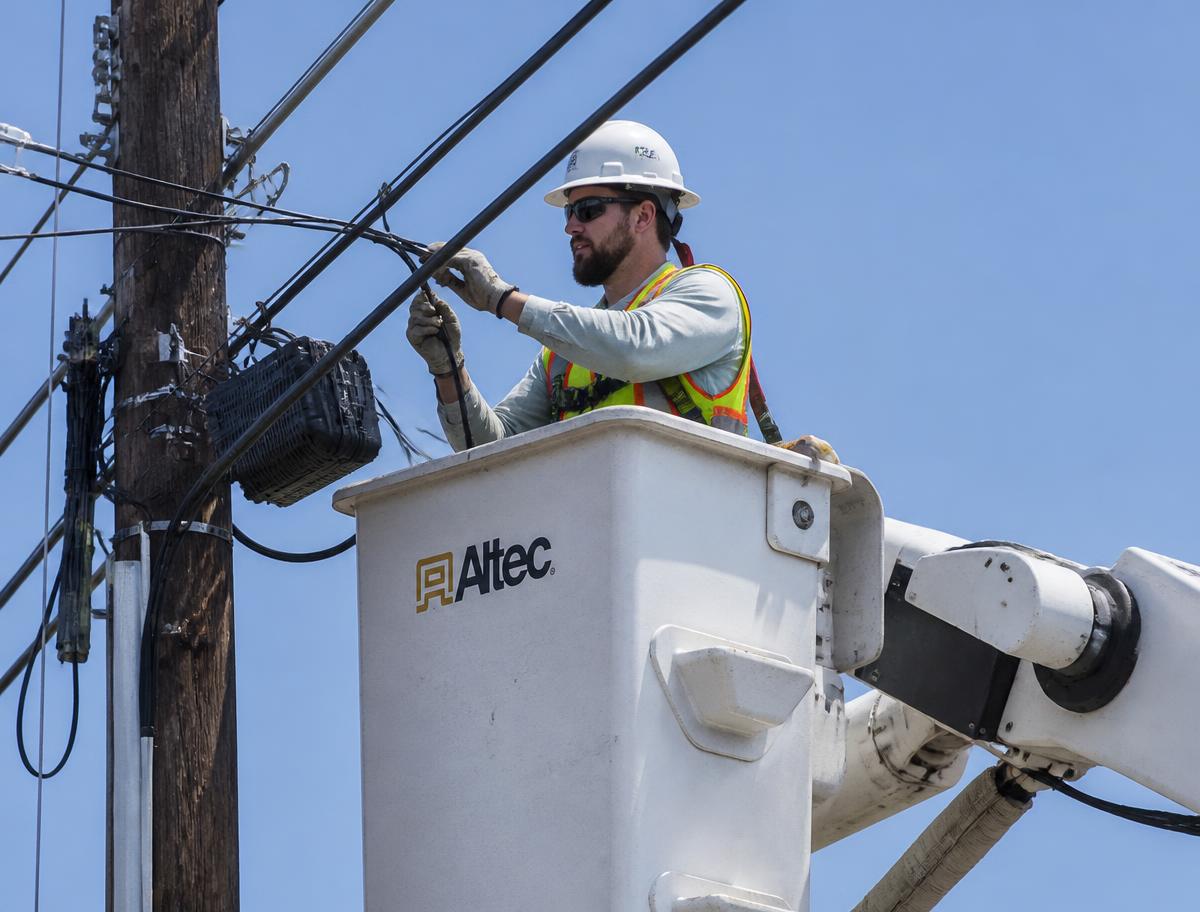
Communications Infrastructure Technicians build and maintain the physical backbone of the internet: fiber optic runs, copper feeds, wireless equipment, and the enclosures that protect them. They pull cable, splice fiber, mount hardware, test circuits, and document the result so the network can be turned up.
A typical workday
A typical day starts with a job briefing and a safety check, then moves into the field. You might splice fiber in the morning, test and certify circuits after lunch, and close out with photos and documentation. Every site is different, which is why this career rarely feels repetitive.
Career outlook
Fiber expansion, rural broadband funding, and wireless upgrades keep demand for field technicians high year after year. Experienced techs move into lead tech, foreman, and project management roles with significant pay increases.
Why AI cannot replace this career
AI can design a network and plan a route, but it cannot climb, dig, pull, splice, or physically prove a circuit works. Every foot of fiber still gets placed by a trained human, which is exactly why this is one of the jobs AI won't replace.
Skills you learn
- Fiber optic splicing and testing
- Copper and coax termination
- Job site and aerial safety
- OTDR and power meter testing
- Reading prints and site documentation
Industries hiring
- Telecommunications carriers
- Broadband and fiber contractors
- Utilities and municipalities
- Wireless and tower services
Who this career is best for
People who want variety, do not want a desk, and like the idea of seeing something they built serve an entire community.
Security Systems Technician
One of the most versatile skilled trade careers in technology, and a common launching point for technicians who eventually run their own security integration business.
Typical salary range
$42,000 to $75,000 per year
Pay varies by location, experience, certifications, overtime, and employer. Entry level technicians typically start near the lower end and move up as they add certifications and field experience.
- Program length:8 weeks
- Format:100% online
- Workforce grants:Available for many students
- Job outlook:High demand
- AI risk:Very low
What they do
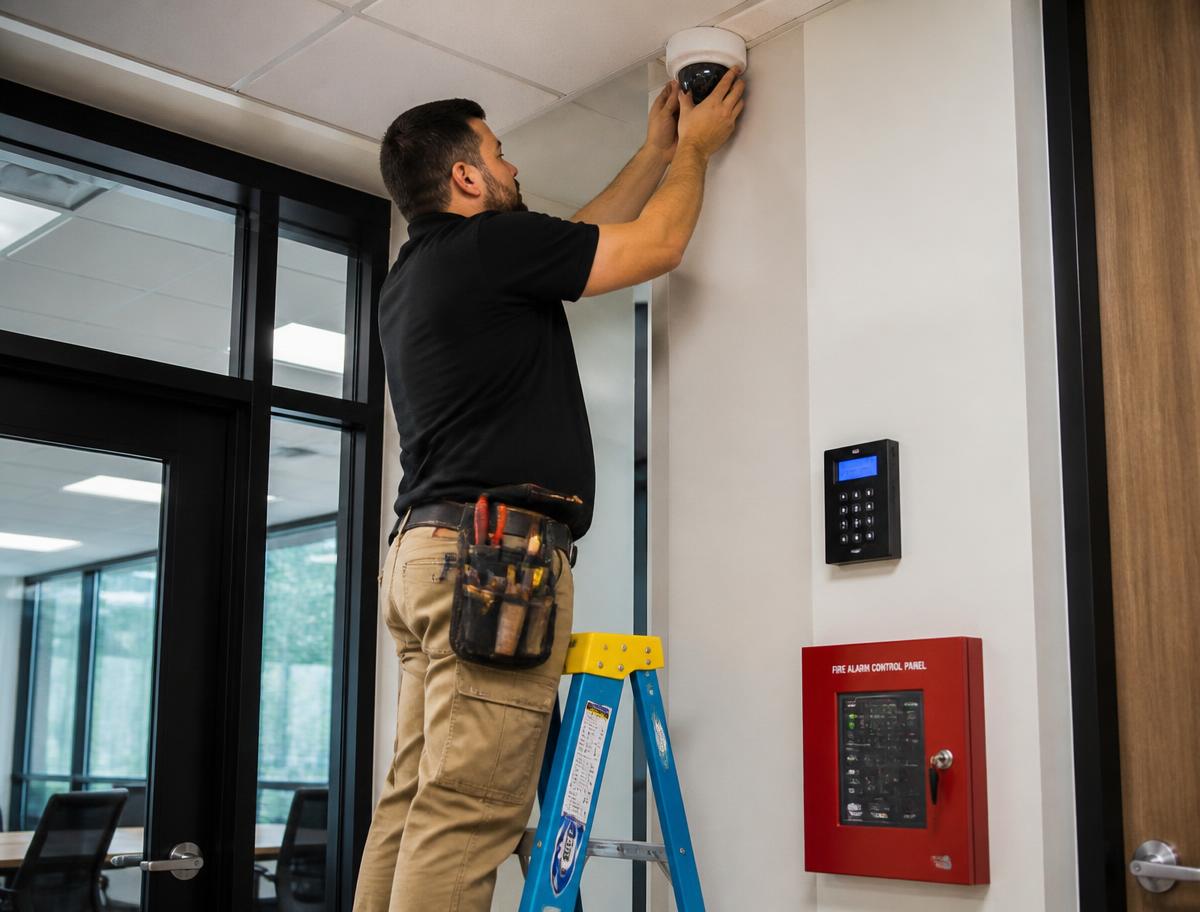
Security Systems Technicians install and service the systems that keep modern buildings safe and connected: security cameras (CCTV), access control, intrusion alarm systems, intercom, audio and visual systems, and smart building technology. They run cable, mount devices, program panels, and commission systems with the customer.
A typical workday
Most days are spent inside commercial buildings, schools, hospitals, or retail spaces. You will pull cable to camera and reader locations, terminate and label, program the alarm or access control panel, and walk the customer through the finished system before signing off.
Career outlook
Every new and renovated building adds more cameras, readers, and connected devices, and each one needs a technician to install and service it. Security systems workforce training also transfers cleanly into service management or starting your own integration company.
Why AI cannot replace this career
Software can analyze a camera feed, but it cannot mount the camera, run the cable, or troubleshoot a bad termination behind a wall. These are careers safe from AI because the work happens in physical space.
Skills you learn
- Security camera (CCTV) installation and aiming
- Access control wiring and programming
- Intrusion alarm system installation and testing
- Intercom and audio/visual system setup
- Smart building technology and system commissioning
Industries hiring
- Security integrators
- Commercial construction
- Education and healthcare facilities
- Smart building and AV contractors
Who this career is best for
Detail-oriented people who enjoy clean, precise installation work and talking with customers about the security systems they rely on.
Structured Cabling Technician
The fastest route into the industry, and the skill set almost every other infrastructure career is built on top of.
Typical salary range
$40,000 to $70,000 per year
Pay varies by location, experience, certifications, overtime, and employer. Entry level technicians typically start near the lower end and move up as they add certifications and field experience.
- Program length:8 weeks
- Format:100% online
- Workforce grants:Available for many students
- Job outlook:High demand
- AI risk:Very low
What they do
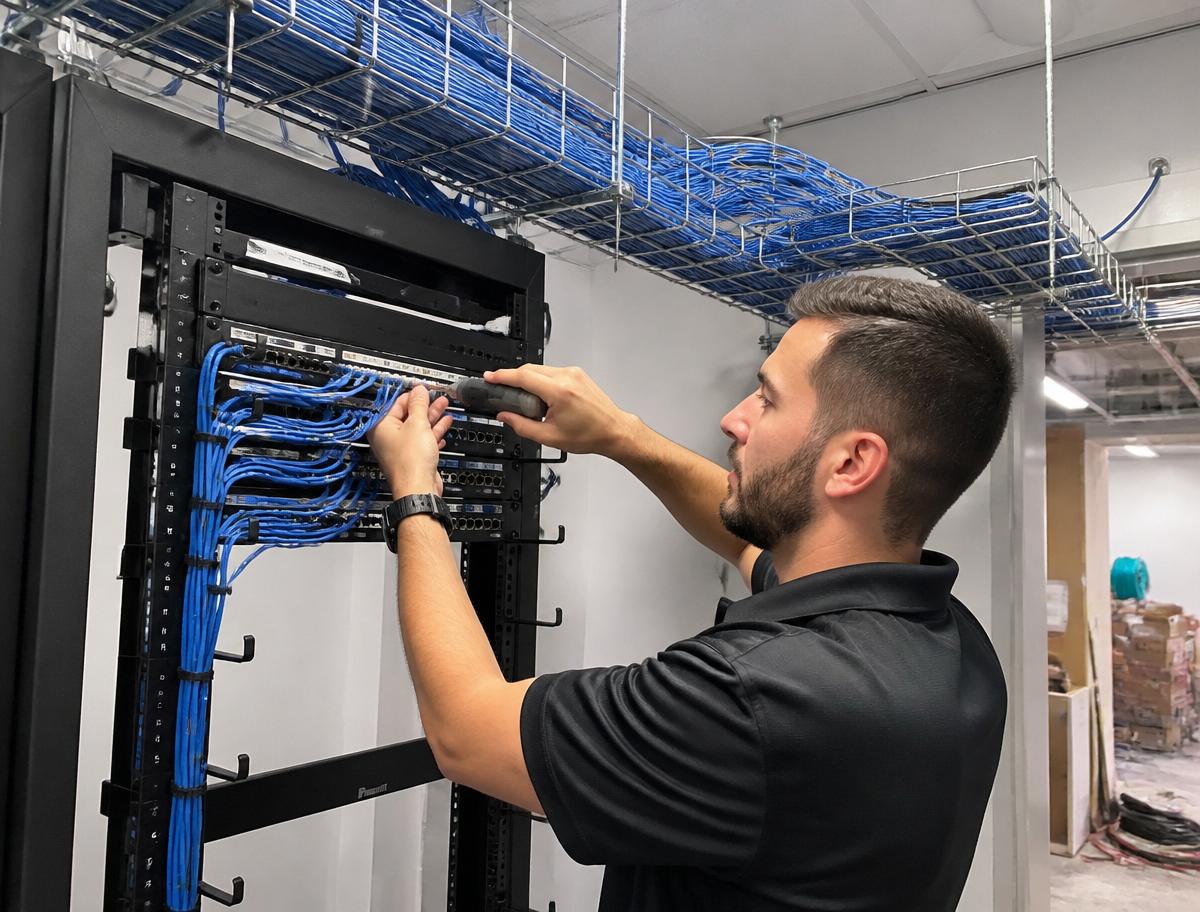
Structured Cabling Technicians install, terminate, and certify the standards-based cabling systems that connect every device in a building. They dress and manage pathways, terminate jacks and panels, label to spec, and test every link so the customer receives a certified, warrantable system.
A typical workday
Days often start on a construction site or in an active office after hours. You will rough in pathways, pull and dress cable, terminate patch panels, then certify each run with a tester and hand over the results as part of the closeout package.
Career outlook
Cabling is the first trade on site and the last to leave, so entry level demand stays steady. Many technicians move up to lead installer or cabling supervisor within a few years.
Why AI cannot replace this career
A certified link is proof that a human physically installed and tested it. No model can pull a cable through a wall, dress a rack, or prove a run passes at 10 gigabit. That is what makes structured cabling a career safe from AI.
Skills you learn
- Copper and fiber termination
- Cable pathway and support systems
- TIA and BICSI style standards
- Certification testing and reporting
- Labeling and as-built documentation
Industries hiring
- Data and communications contractors
- Commercial construction
- Corporate campuses and data centers
- Government and defense facilities
Who this career is best for
Practical people who want to get employed quickly, learn on the job, and see measurable results at the end of every day.
Network Infrastructure Technician
The most technology-forward of the four AI-proof careers, and a direct path into data center work.
Typical salary range
$48,000 to $90,000 per year
Pay varies by location, experience, certifications, overtime, and employer. Entry level technicians typically start near the lower end and move up as they add certifications and field experience.
- Program length:8 weeks
- Format:100% online
- Workforce grants:Available for many students
- Job outlook:High demand
- AI risk:Very low

What they do
Network Infrastructure Technicians build and maintain the equipment side of the network: racking and stacking switches, patching, power and cooling awareness, cable management, hardware swaps, and physical troubleshooting when a link goes down.
A typical workday
You will spend the day indoors in data centers, network closets, and equipment rooms. Tickets come in, you trace and verify the physical path, replace or repatch what failed, and document the change so the network stays accurate.
Career outlook
The AI boom itself is building data centers at record pace, and every one of them needs technicians on the floor. This is a technology career with a clear ladder into network operations and infrastructure leadership.
Why AI cannot replace this career
Ironically, AI increases demand here. Models need hardware, hardware needs racking, patching, cooling, and hands on repair. Artificial intelligence cannot swap its own optic or repatch its own port.
Skills you learn
- Rack, stack, and patching
- Structured cable management
- Physical layer troubleshooting
- Hardware replacement procedures
- Change and asset documentation
Industries hiring
- Data centers and colocation providers
- Cloud and hosting companies
- Enterprise IT departments
- Managed service providers
Who this career is best for
Analytical, organized people who love technology and want an indoor career with long-term growth.
Which AI-Proof Career Fits You Best?
Most students arrive unsure, and that is completely normal. Whether you're making a career change, leaving the military, or starting your first skilled trade career, a short conversation with an advisor is usually all it takes to narrow it down. Tell us what you enjoy and what you want your week to look like, and we'll help you choose the AI-resistant career path and online career training that fits your interests and goals.
Contact AdmissionsYour training may be funded
Many students qualify for workforce grants or tuition assistance that can significantly reduce, and sometimes fully cover, the cost of training for these AI-proof jobs. Flexible payment options are available if grant funding isn't a fit.
Learn About Tuition & GrantsCareer Path FAQs
Get clear answers about each AI-resistant career path, from beginner requirements to long-term growth and why these jobs are safe from AI.
Questions About AI-Proof Careers and Training
Quick answers about getting started, tuition, grants, and what to expect from AI-resistant career training.

Start Building Your AI-Proof Career Today
Pick the path that fits you, apply online, and start training for a hands-on technology career AI can't replace. Review tuition and workforce grants, read our program FAQs, head back to the home page, or contact admissions and we'll walk you through programs, timelines, and workforce grant options.